Moneda lunii
martie 2026: The Great God of Odessos
The Coin of this Month is presented by Rosa Ludwig
The city was founded at the beginning of the 6th century BC on the western coast of the Pontus Euxinus by settlers of the Greek city of Miletus (Ptol. 3.10.8; 8.11.6; Plin. Nat. hist. 4.45). Odessos was probably established on the site of an earlier Thracian settlement. The city initially remained under the influence of its mother city and later became a member of the Delian League. In the 4th century BC, it came under the control of Thracian tribes. Around 341 BC, Philip II of Macedon made the city his ally. After the death of Alexander the Great, Odessos fell under the rule of Lysimachus.
In 313 BC, Odessos led the revolt of several cities against the Diadochi. The revolt failed, and it was only after the death of Lysimachus that the city regained its self-government, marking the beginning of a period of economic prosperity. As a port city in a highly advantageous location, Odessos traded extensively in precious metals. At the end of the 2nd century BC, the city supported Mithridates VI of Pontus in his wars against the Romans. This was followed by turbulent years. In 71 BC, it was forced to surrender to the general Licinius Lucullus. It was subsequently subjugated by the Dacians under Burebista. After his death, Odessos fell under Thracian control, including that of Sadalas II. In the 1st century AD, Odessos was finally incorporated into the Roman province of Moesia Inferior, ushering in another period of prosperity.
The material remains of Odessos, especially from the first centuries of its existence, are scarce. The city did not begin minting coins until the mid-4th century BC, producing gold and silver coins based on the Attic standard.
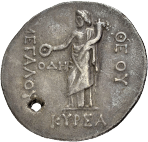
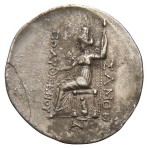
The coin of the month was struck during the Hellenistic period. The tetradrachm follows a reduced Attic standard. Despite the perforation, it makes a striking impression today, large, lustrous, and only slightly tarnished.
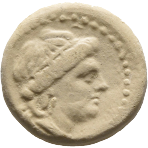
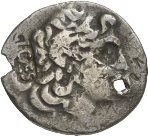
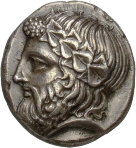
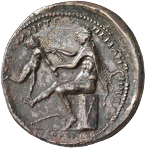
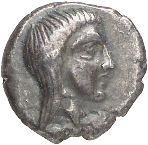
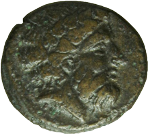
The obverse shows the head of a bearded man facing right. His curly hair is bound with a diadem. On the reverse, a bearded male figure stands facing left. He wears a long robe that is draped over his upper body, leaving only his left shoulder covered. In his outstretched right hand, he holds an object that can be interpreted as a phiale. In his left arm, held close to his body, he holds a cornucopia. The depiction is very detailed. The folds of the robe, the musculature of the upper body, the face and hair of the male figure are intricately worked, and a vine with grapes and leaves can be discerned emerging from the cornucopia. The figure is surrounded on three sides by a legend. To his right is ΘΕΟΥ, to his left ΜΕΓΑΛΟΥ, identifying the figure as Theos Megas, “the Great God”.
The abbreviated ethnic ΟΔΗ can be seen beneath the phiale. This clearly identifies the coin as an issue of Odessos. In the exergue, the abbreviated name KYPΣΑ can be read. A graffito incised around the god's head on the reverse—A-ΔΗΕ(?)—is also visible; the meaning of these letters remains unclear.
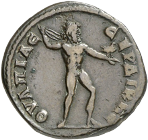
The motif of the great god appears in coin-issuing cities on the western coast of the Black Sea, such as Odessos, Tomis and Dionysopolis. The deity is depicted reclining or as a horseman. The physiognomy of a mature man and the cornucopia remain his attributes. The coin image shown here depicts another well-known iconographic type of the great god with the sacrificial bowl. In Roman times, the diadem was sometimes replaced by a kalathos. Theos Megas is not a well-known deity and, despite several attempts by scholars, cannot be integrated into the canon of the Greek pantheon. Iconographic parallels with Zeus or Hades—such as the cornucopia—can be drawn, but Theos Megas cannot be equated with them. Identifying him with Sarapis has likewise not been confirmed, although this god is depicted similarly in the Hellenistic period. Whether there is a connection with the Great Gods of Samothrace also remains uncertain.
In the wider Odessos region, the Thracian god Darzalas is attested. It has often been assumed that Theos Megas and Darzalas represent the same deity and that the two names are merely synonymous. As Gočeva has shown, however, their direct identification occurs only in the 3rd century AD, when Theos Megas Darzalas appears as the eponym of the city of Odessos on an ephebic list. At this time, games were organised and priests appointed for the god, who increasingly assumed the role of protector of the city. He also appears frequently on the reverse of Roman coins. The merging of Theos Megas and Darzalas into a single deity is clearly connected with the growing importance of the Thracian population in the city and the region.
In the Hellenistic period, however, the situation seems to have been different. The settlers of Odessos had brought Apollo with them as their patron deity, and he retained this role for a long time, as reflected in the city's early coinage. In the late 3rd and 2nd centuries BC, however, the Great God was introduced. His attributes recall Zeus, Hades, Asclepius, or Dionysus, yet on some coins—such as the present tetradrachm—he is explicitly named Theos Megas. The coin therefore unambiguously links the name of the deity with a specific iconographic type.
Several attestations of the god in the Odessos region date to the Hellenistic period, including terracotta figurines and a small Doric temple at Istros dedicated to Theos Megas. Yet the precise origin of the deity remains uncertain. During the Hellenistic period, he became the patron god of the city alongside Apollo, but the circumstances of his emergence are unclear. As noted above, he does not initially appear to have been associated with Darzalas and is more plausibly a Greek creation. Killen has suggested that he functioned as a parasemon of Odessos—that is, as a distinctive emblem of the city and its Greek inhabitants, serving to demarcate them as Hellenes in contrast to the surrounding Thracian population. At the same time, this emblematic deity distinguished Odessos from other Greek colonial foundations.
An alternative explanation is that the Greek inhabitants of Odessos adopted and reinterpreted an ancient local god who was believed to have protected the city from time immemorial. In this process, Greek conceptions of divinity merged with Thracian religious traditions, producing a ‘hybrid’ deity who cannot be identified either with Darzalas or with Zeus, but who emerged as Theos Megas. It is plausible to locate the genesis of this cult in the Hellenistic period, when the port city was consolidated and experienced economic prosperity. Relations with the Thracians, formerly marked by conflict, appear to have become more stable and cooperative. Moreover, by this time the descendants of the Milesian settlers had long been established on the Black Sea coast, and a degree of cultural distance from the Greek mainland may be assumed. Whether this situation fostered deliberate differentiation from the Thracians or, conversely, increasing assimilation remains an open question.
Through sustained contact and cultural exchange, a new deity may thus have emerged, whose name and iconography were fixed on the coinage of the period. As already noted, the Great God appears very frequently on Roman coins, albeit without inscription, indicating that by then his iconography was fully standardised and widely recognised.
Dating the tetradrachm remains problematic. The abbreviated name KYPΣΑ on the reverse provides a point of reference and suggests a date toward the end of the 3rd century BC. However, both the iconographic motif and the weight standard point ot an issue after 168 BC. The coin may therefore be dated broadly to between the late 3rd century and the mid-2nd century BC.
The coin of the month for March compellingly illustrates how coinage can function as medium of identity. It appears personal and approachable. The hole and the graffito give the impression of intensive use, possibly extending beyond its role as a mere means of payment. However, what makes it special is the image of Theos Megas, who embodies key aspects of the Hellenistic religious culture. The deity can be interpreted as a unique symbol of the Hellenistic city of Odessos, in which its inhabitants recognised themselves as Hellenes and descendants of the Milesians. At the same time, Theos Megas may also represent a figure with whom the mixed Greek and Thracian population of Odessos could identify. In either case, the coin conveys a motif that emerged from a context of cultural encounter, shaped by processes of both assimilation and conscious differentiation.
Literature
B. Pick und K. Regling. Die antiken Münzen von Dacien und Moesien. Die antiken Münzen Nord-Griechenlands I, 2 (Berlin1910), S. 550, Nr. 2215,2.
Z. Gočeva, Der Kult des Theos Megas-Darzalas in Odessos, WürzbJb 7, 1981, 229-234.
O. Hoover, The Handbook of Coins of Macedon and its Neighbors, II. Thrace, Skythia and Taurike. Sixth to First Centuries BC, The Handbook of Greek Coinage Series III (London 2017).
Z. Gočeva, Organization or Religious Life in Odessos, Kernos 9, 1996, 121-127.
Der neue Pauly 8 (2000) 1106-1107 s. v. Odessos (I. Bodnár).
LIMC VII (1994) 918-919 s. v. Theos Megas (J. Zelazowski).
LIMC III (1986) 354-355 s. v. Darzalas (G. Zlatozara).
S. Killen, Parasema als Identitätsmarker griechischer Poleis in Thrakien, in U. Peter, V. Stolba (Hrsg.), Thrace. Local Coinage and Regional Identity (Berlin 2021), S. 99-105.
A. Michaelis, Sarapis Standing on a Xanthian Marble in the British Museum, Journal of Hellenistic Studies 6 (1885) 302f, Pl. E, 12.
M. J. Price, The Coinage in the Name of Alexander the Great and Philip Arrhidaeus (Zürich 1991) Nr. 1175-1176.
U. Peter, Religious-cultural identity in Thrace and Moesia Inferior, in C. Howgego, V Heuchert (Hrsg.), Coinage and Identity in the Roman Empire (Oxford 2005), S. 107–114.
All Coins/Types of the month:
-
![]() Moneda 2026-3
Moneda 2026-3 -
![]() Moneda 2026-2
Moneda 2026-2 -
![]() Moneda 2026-1
Moneda 2026-1 -
![]() Moneda 2025-12
Moneda 2025-12 -
![]() Moneda 2025-11
Moneda 2025-11 -
![]() Moneda 2025-10
Moneda 2025-10 -
![]() Moneda 2025-9
Moneda 2025-9 -
![]() Moneda 2025-8
Moneda 2025-8 -
![]() Moneda 2025-7
Moneda 2025-7 -
![]() Moneda 2025-6
Moneda 2025-6 -
![]() Moneda 2025-5
Moneda 2025-5 -
![]() Moneda 2025-4
Moneda 2025-4 -
![]() Moneda 2025-3
Moneda 2025-3 -
![]() Moneda 2025-2
Moneda 2025-2 -
![]() Moneda 2025-1
Moneda 2025-1 -
![]() Moneda 2024-12
Moneda 2024-12 -
![]() Moneda 2024-11
Moneda 2024-11 -
![]() Moneda 2024-10
Moneda 2024-10 -
![]() Moneda 2024-9
Moneda 2024-9 -
![]() Moneda 2024-8
Moneda 2024-8 -
![]() Moneda 2024-7
Moneda 2024-7 -
![]() Moneda 2024-6
Moneda 2024-6 -
![]() Moneda 2024-5
Moneda 2024-5 -
![]() Moneda 2024-4
Moneda 2024-4 -
![]() Moneda 2024-3
Moneda 2024-3 -
![]() Moneda 2024-2
Moneda 2024-2 -
![]() Moneda 2024-1
Moneda 2024-1 -
![]() Moneda 2023-12
Moneda 2023-12 -
![]() Moneda 2023-11
Moneda 2023-11 -
![]() Tip 2023-10
Tip 2023-10 -
![]() Moneda 2023-9
Moneda 2023-9 -
![]() Moneda 2023-8
Moneda 2023-8 -
![]() Moneda 2023-7
Moneda 2023-7 -
![]() Moneda 2023-6
Moneda 2023-6 -
![]() Moneda 2023-4
Moneda 2023-4 -
![]() Moneda 2023-3
Moneda 2023-3 -
![]() Moneda 2023-2
Moneda 2023-2 -
![]() Moneda 2023-1
Moneda 2023-1 -
![]() Moneda 2022-12
Moneda 2022-12 -
![]() Moneda 2022-11
Moneda 2022-11 -
![]() Moneda 2022-10
Moneda 2022-10 -
![]() Moneda 2022-9
Moneda 2022-9 -
![]() Moneda 2022-8
Moneda 2022-8 -
![]() Moneda 2022-7
Moneda 2022-7 -
![]() Moneda 2022-6
Moneda 2022-6 -
![]() Moneda 2022-5
Moneda 2022-5 -
![]() Moneda 2022-4
Moneda 2022-4 -
![]() Moneda 2022-3
Moneda 2022-3 -
![]() Moneda 2022-2
Moneda 2022-2 -
![]() Moneda 2022-1
Moneda 2022-1 -
![]() Moneda 2021-12
Moneda 2021-12 -
![]() Moneda 2021-11
Moneda 2021-11 -
![]() Tip 2021-10
Tip 2021-10 -
![]() Moneda 2021-9
Moneda 2021-9 -
![]() Moneda 2021-8
Moneda 2021-8 -
Moneda 2021-7
-
![]() Moneda 2021-6
Moneda 2021-6 -
![]() Moneda 2021-5
Moneda 2021-5 -
![]() Moneda 2021-4
Moneda 2021-4 -
![]() Moneda 2021-3
Moneda 2021-3 -
![]() Moneda 2021-2
Moneda 2021-2 -
![]() Moneda 2021-1
Moneda 2021-1 -
![]() Moneda 2020-12
Moneda 2020-12 -
![]() Moneda 2020-11
Moneda 2020-11 -
![]() Moneda 2020-10
Moneda 2020-10 -
![]() Moneda 2020-9
Moneda 2020-9 -
![]() Moneda 2020-8
Moneda 2020-8 -
![]() Tip 2020-7
Tip 2020-7 -
![]() Moneda 2020-6
Moneda 2020-6 -
![]() Moneda 2020-5
Moneda 2020-5 -
![]() Moneda 2020-4
Moneda 2020-4 -
![]() Moneda 2020-3
Moneda 2020-3 -
![]() Moneda 2020-2
Moneda 2020-2 -
![]() Moneda 2020-1
Moneda 2020-1 -
![]() Tip 2019-12
Tip 2019-12 -
![]() Moneda 2019-11
Moneda 2019-11 -
![]() Moneda 2019-10
Moneda 2019-10 -
![]() Moneda 2019-9
Moneda 2019-9 -
![]() Moneda 2019-8
Moneda 2019-8 -
![]() Moneda 2019-7
Moneda 2019-7 -
![]() Moneda 2019-6
Moneda 2019-6 -
![]() Moneda 2019-5
Moneda 2019-5 -
![]() Moneda 2019-4
Moneda 2019-4 -
![]() Moneda 2019-3
Moneda 2019-3 -
![]() Moneda 2019-2
Moneda 2019-2 -
![]() Moneda 2019-1
Moneda 2019-1 -
![]() Moneda 2018-12
Moneda 2018-12 -
![]() Moneda 2018-11
Moneda 2018-11 -
![]() Moneda 2018-10
Moneda 2018-10 -
![]() Moneda 2018-9
Moneda 2018-9 -
![]() Moneda 2018-8
Moneda 2018-8 -
![]() Moneda 2018-7
Moneda 2018-7 -
![]() Moneda 2018-6
Moneda 2018-6 -
![]() Moneda 2018-5
Moneda 2018-5 -
![]() Moneda 2018-4
Moneda 2018-4 -
![]() Moneda 2018-3
Moneda 2018-3 -
![]() Moneda 2018-2
Moneda 2018-2 -
![]() Moneda 2018-1
Moneda 2018-1 -
![]() Moneda 2017-12
Moneda 2017-12 -
![]() Moneda 2017-11
Moneda 2017-11 -
![]() Moneda 2017-10
Moneda 2017-10 -
![]() Moneda 2017-9
Moneda 2017-9 -
![]() Moneda 2017-8
Moneda 2017-8 -
![]() Moneda 2017-7
Moneda 2017-7 -
![]() Moneda 2017-6
Moneda 2017-6 -
![]() Moneda 2017-5
Moneda 2017-5 -
![]() Moneda 2017-4
Moneda 2017-4 -
![]() Moneda 2017-3
Moneda 2017-3 -
![]() Moneda 2017-2
Moneda 2017-2 -
![]() Moneda 2017-1
Moneda 2017-1 -
![]() Moneda 2016-12
Moneda 2016-12 -
![]() Moneda 2016-11
Moneda 2016-11 -
![]() Moneda 2016-10
Moneda 2016-10 -
![]() Moneda 2016-9
Moneda 2016-9 -
![]() Moneda 2016-8
Moneda 2016-8 -
![]() Moneda 2016-7
Moneda 2016-7 -
![]() Moneda 2016-6
Moneda 2016-6 -
![]() Moneda 2016-5
Moneda 2016-5 -
![]() Moneda 2016-4
Moneda 2016-4 -
![]() Moneda 2016-3
Moneda 2016-3 -
Moneda 2016-2
-
![]() Moneda 2016-1
Moneda 2016-1 -
![]() Moneda 2015-12
Moneda 2015-12 -
![]() Moneda 2015-11
Moneda 2015-11 -
![]() Moneda 2015-10
Moneda 2015-10 -
![]() Moneda 2015-9
Moneda 2015-9 -
![]() Moneda 2015-8
Moneda 2015-8 -
![]() Moneda 2015-7
Moneda 2015-7 -
![]() Moneda 2015-6
Moneda 2015-6 -
![]() Moneda 2015-5
Moneda 2015-5 -
![]() Moneda 2015-4
Moneda 2015-4 -
![]() Moneda 2015-3
Moneda 2015-3 -
![]() Moneda 2015-2
Moneda 2015-2 -
![]() Moneda 2015-1
Moneda 2015-1 -
![]() Moneda 2014-12
Moneda 2014-12 -
![]() Moneda 2014-11
Moneda 2014-11 -
![]() Moneda 2014-10
Moneda 2014-10 -
![]() Moneda 2014-9
Moneda 2014-9 -
![]() Moneda 2014-8
Moneda 2014-8